 Log in


This week, I have been buried under a series of story tips and reporting leads that I’m excited about, that I think are important, and that I am anxious to get into the world. But I woke up today and realized that I could simply no longer ignore a simmering drama that has been on my radar for weeks that is now breaking containment and demands attention: The YouTube LEGO drama, aka Bricks & Minifigs scandal.
It is, unfortunately, impossible to succinctly or fully explain the YouTube LEGO drama, for I believe it is impossible for one to fully understand or suss out every angle of what is going on. The drama is buried in dozens of YouTube videos—many of which are hours long—police reports, local news reports, police body camera footage (!), cease and desist letters, hostage-style vertical video statements, and more. But it is important that you are at the very least aware of it, and that you know it is occurring, because it is fucking crazy.
One of the things we aspire to do at 404 Media is to amplify the most important stories in individual communities to a wider audience, and this is one such case, which touches on so many things we are at least kind of interested in, is tearing apart the LEGO community, is one of the most popular things happening on YouTube right now, and appears to have become the most important local news story in a small town in Utah called American Fork.
I am not the only one who feels this way. TechDirt’s Mike Masnick, in a post titled “Everyone in This LEGO Dispute Should Have Spoken to a Lawyer Earlier Than They Did,” describes it thusly: “If you haven’t been following the Bricks & Minifigs saga, congratulations on your peaceful existence. It’s a genuinely difficult story to track, partly because you have to watch a bunch of long YouTube videos to piece it together, and partly because almost everyone covering it is pushing a specific angle.”

I could not agree with Masnick more, and if you do not like my writing and want a more detailed legal analysis, then his 6,000-word blog is a good place to go. The drama has spawned its own Wikipedia page called “Bricks & Minifigs—Reckless Ben Controversy,” various Reddit Out of the Loop posts and a “megathread” about the saga on the LEGO subreddit, and local coverage including “Utah agencies inundated with calls as American Fork Police faces controversy over LEGO YouTuber arrest,” which are also good places to track what’s going on.
Despite this insane intro in which I have yet to explain anything about the scandal, I will try to be brief so that you can at least tell your friends “hey did you hear about this insane LEGO shit” and you can then laugh and/or cry.
WHAT IS GOING ON (I THINK)(ALSO MASSIVELY ABBREVIATED):
Bricks & Minifigs is a chain of independent LEGO stores that has a series of franchises around the country. A thing that at least some Bricks & Minifigs stores do is consignment. In 2023, a man named Ed Mansell and his son Bryan asked a Bricks & Minifigs store in Salem-Keizer, Oregon, to sell their collection of LEGO bricks, which, according to the store itself, was worth “over $200,000.” The store began to sell this collection, but then the owner of the franchise changed hands and was taken over by Bricks & Minifigs corporate. At this point, Bryan attempted to either get the unsold portion of his collection back or money for the collection. Bryan, apparently, was told to pound sand.
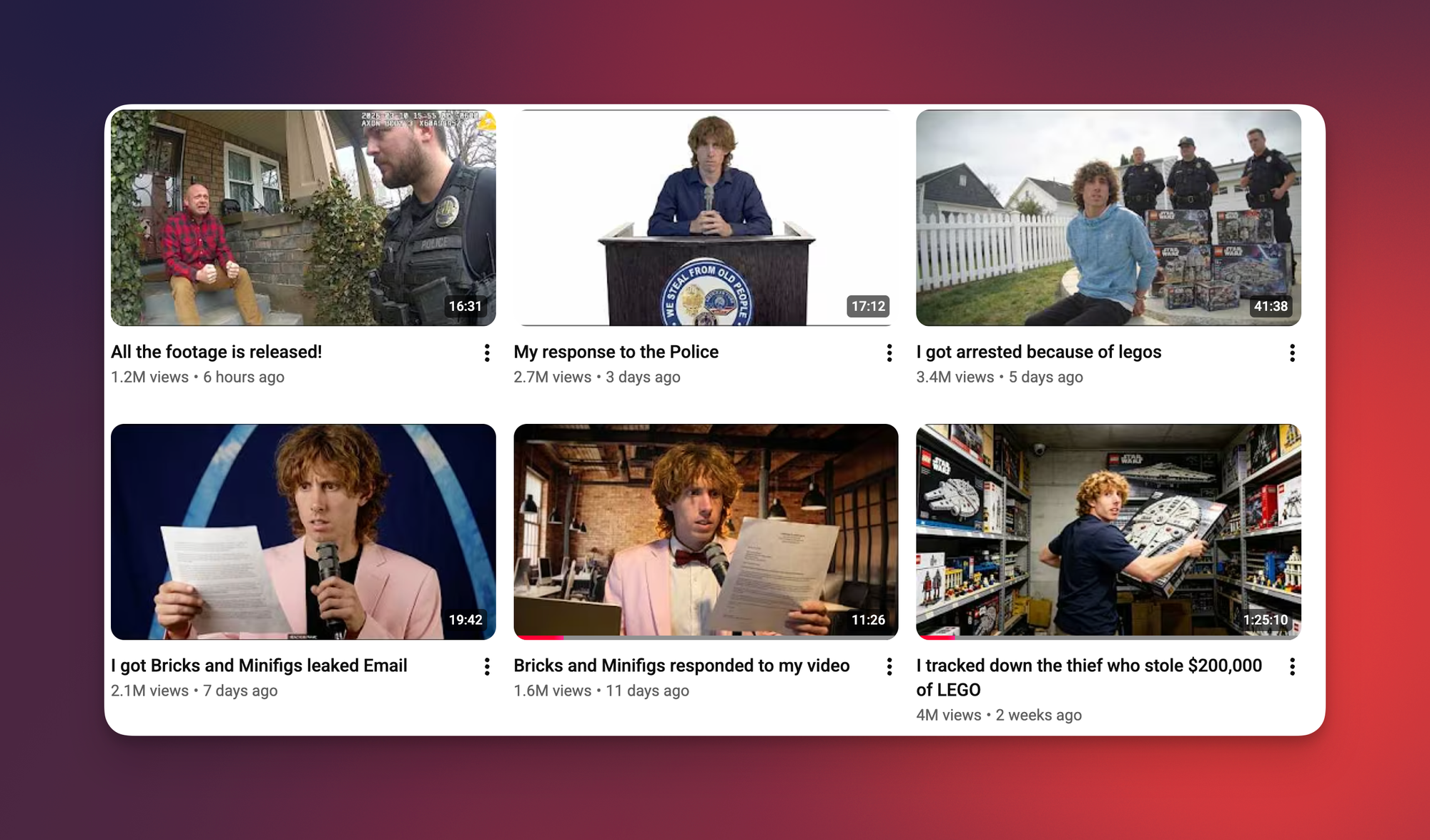
Bryan then contacted a YouTuber with a million followers named Ben Schneider, who goes by “Reckless Ben” on YouTube. Reckless Ben made a series of YouTube videos, starting with the hour-and-a-half-long “I tracked down the thief who stole $200,000 of LEGO,” which currently has 4 million views. Schneider basically did a series of wacky but also funny things to draw attention to the matter, which included putting a giant sign on the shuttered Bricks & Minifigs store in question that read “Permanently closed. We stole a family’s life savings. They sued. We lost. By closing the store, we got out of having to pay the family what we owe them.” (Bricks & Minifigs claims that the store was instead “closed temporarily because our staff—including local teenagers—faced severe real-world safety hazards, targeted in-person stalking, and explicit bomb threats driven by viral videos.”)
There are various other things Schneider did in the video, which included starting a company called “We Steal From Old People,” which are possibly funny but also not necessarily relevant. Schneider also set up a GoFundMe page for Bryan, which has currently raised $382,000.
As part of all of this, Schneider went to Bricks & Minifigs headquarters in Utah in March as well as the home of one of its executives; Schneider was arrested by American Fork, Utah police and charged with stalking and targeted residential picketing. Local news reported he was also separately arrested in American Fork on charges of disorderly conduct and criminal trespass.
After Schneider’s video came out, Bricks & Minifigs got pissed at him and has posted two different, very long blogs about the incidents that the company says has required them to “process a massive wave of online chaos.” The company basically says that this is a big misunderstanding, that Schneider’s videos are unfair, that its employees are now getting harassed, and that the LEGO bricks at issue weren’t actually worth $200,000, anyway.
Understandably, Schneider has turned this response into additional content, which has also gone viral. Then, this week, body camera footage of Schneider being arrested by American Fork police was released and is being pored over by the community. The American Fork police department also quite possibly created a brand new YouTube channel to release an extremely bizarre, 30-minute YouTube video filmed in a facsimile of The Matrix’s The Construct void room about the arrests that simply must be seen to be believed. The police do not come off looking good in any of this, and it is clear from the body camera footage and the entire thing that the police have handled all of this terribly.
THEN, Bricks & Minifigs sent a cease-and-desist letter to Patreon, asking them to take down Reckless Ben’s Patreon, where he has been posting further updates and early access to future videos about the saga behind a paywall. Patreon’s CEO Jack Conte filmed a hostage-style video about this takedown request and said that “after an extensive review … we have determined that Bricks & Minifigs can stuff it. We’re keeping Ben’s page up. And if Bricks & Minifigs doesn’t like that, they can sue us. Patreon out.”
That’s more or less where we’re at today, factswise.
THE FALLOUT / WHO CARES
Again, I am glossing over much of what has happened here because to try to parse all of it would take many, many hours of my and your time and would result in even more excruciating detail than I have already provided. This has become a major, major deal in the LEGO community, on YouTube, and in the Utah and Oregon communities where this all happened. It is extremely feeding the content industry—here’s just a tiny sample of some videos from the YouTube commentariat about the saga:
Bricks & Minifigs CEO Responded…And Made Everything Worse (478,000 views, LEGO Empire)
I Help YouTuber Arrested Over Lego Videos (Part 1) (2.8 million views, The Civil Rights Lawyer)
LEGO Scandal Explodes as YouTuber ‘Reckless Ben’ is Arrested Twice (104,000 views, Law&Crime Network)
‘We Never Thought It Would Get This Crazy.’ Reckless Ben on what’s next in viral Lego Case (450,000 views, Fox 5 Washington DC)
The Lego Bodycam Footage Has Been Released (140,000 views, xQc)
Bricks & Minifigs IS DEAD ($200K STOLEN LEGO) (83,000 views, TNT_Bricks)
LEGO Scandal Company Response Is Horrible (2.4 million views, penguinz0)
RICO Suits and Restraining Orders: The Bricks & Minifigs Chaos Just Got WORSE (388,000 views, Lawful Masses With Leonard French)
As Masnick explains in his article, this should have been sorted out by lawyers probably years ago, but it was not. What is happening now is classic YouTuber drama that has spilled out into the normie “real world,” which I say not derisively but because objectively we have a bunch of police officers and local news outlets and local governments wondering what the fuck is going on. This happens a couple times a year, such as in 2020 when the YouTuber Boogie2988 went to another YouTuber’s house and shot a gun into the air. It happens when YouTubers get swatted, arrested, or otherwise intersect with broader society.
Here are local news stories about the scandal:
Nationwide LEGO resale store caught up in alleged theft scandal, YouTuber lawsuit (Fox 54)
Conflict Over Purportedly Stolen Legos Leads to Accusations of Misconduct Against American Fork Police Department (ABC4)
The latest on Keizer Bricks & Minifigs and Prized Star Wars Lego Set (Statesman Journal)
Sign on Shuttered Keizer Store Accuses Bricks & Minifigs of Lego Theft (Statesman Journal)
Utah Agencies Inundated by Calls as American Fork Police Faces Controversy Over LEGO YouTuber Arrest (ABC 4)
‘I Just Thought It Was Such a Crazy Level of Injustice’: YouTuber at Center of Lego Dispute Speaks, Explains Why He Got Involved in the First Place (ABC4)
A dispute over a prized Star Wars Lego collection led to a YouTube crusade. Then came the stalking charges in Utah. (Salt Lake Tribune)
This is all to say that this is YouTube drama executed perfectly by all involved, and perhaps the most disastrous brand response one could imagine. Bricks & Minifigs could have sorted this out ages ago but did not; it has since become a massive clusterfuck and content bomb for all involved. The cops have made it astronomically worse. The perfect internet story.



quote this with a lowkey pixar banger that anticipated the future. make an indie band name worse. without downloading any new pics, share your thoughts on the coen brothers' 2008 film burn after reading. tell me you're from claremont virginia's class of 2008 with one webp. remember 2008. you will return to 2008. 2008 is waiting for you

Every once in a while, for my job, I have to create a gigantic list of features associated with a random game's existing dialogue system.
A lot of creative directors will recall the dialogue system of a game they love, then say to the narrative team, "give me that exactly." Then you've gotta figure out what "that" is, exactly. It's usually a lot more complex than you've anticipated!
Dialogue systems cover a ton of edge cases emerging from player movement, game state, UI navigation flow, and more. I often find myself dimly remembering what a game did to handle the unique narrative cases at the very end of the plot, then dooming myself to play through the entire game, or to watch multiple different Let's Plays and hope that I can find an example of player pressing every available button. For example, Pokemon Scarlet and Violet have, essentially, a font, plus some weird text UX, which are only used in the dialogue of the final boss, in the last 30 minutes of the plot. Pokemon Z-A mixes combat UI with dialogue UI and cutscene-style visual language in the climactic final battle. If I wanted to write out the full spec for the dialogue system for either of those games, I'd need to be looking at material you only unlock after 30+ hours of play. It's a chore!
It's also very educational. If you have recently started working in games narrative and want to know more about how these systems function, I think it can be enormously educational to try and write out every single thing that a game's dialogue system does - even the weird shit that games sometimes save for their final bosses or climactic setpieces.
Writing down everything that happens in a game's dialogue system could mean recording every single way that the game handles a player entering or exiting dialogue. Are there any scenes where the player is KOed during dialogue? Scenes where the player is forced into dialogue? Scenes where the player triggers a dialogue scene from an unexpected menu, like their inventory? You'll have to screenshot them all and describe how audio and text UI work in these unusual cases. If a game has 3D camera angles paired with dialogue, you can try to record all the different camera techniques used. Is the camera moving during dialogue? How does it move? How does the game act when the player advances dialogue while this stuff is onscreen? You can really get into the weeds with this shit.
I have written out spec documents for existing games which attempted to describe every single UI animation used during dialogue. It wasn't useful to anyone, but it really taught me a lot about how unexpectedly complex even the simplest one of these systems can be.
I think the two most interesting games I've recently done this for were Final Fantasy XIV and Arctic Eggs. Arctic Eggs does really fun, playful, unusual things with text. FFXIV uses a bazillion different text and VO delivery systems so flexibly and in so many crazy combinations that it kind of functions as a lesson on game production. It's a lot of fun to track how that game uses cheaper narrative systems for more frequently-seen, low-effort content, then dumps money on a few high-budget cutscenes per expansion. You can learn a ton from seeing where different dialogue systems use their more expensive, complex, arted-up techniques.
Anyway!! Strongly recommend this shit. It'll give you all sorts of genius ideas. And it's a great way to justify playing games at work........
Next Page of Stories